

Dinosaur Discovery Track
Come on a journey and discover the wonderful and mysterious world of dinosaurs.
Plant-eating dinosaurs
A herbivore is an animal that eats plant matter – like a giraffe or rhino – and has flatter teeth for chewing leaves and plants. Herbivorous dinosaurs had strong beaks for ripping plants or lots of teeth for cutting and snipping them.
Everything we know about Amargasaurus comes from a single specimen. Although it is only one specimen, it is nearly a full skeleton which is uncommon for fossil finds.
Amargasaurus is part of the sauropod family (long-necked dinosaurs). However, it is part of a unique group of dwarfed, short-necked sauropods. The smaller size may have been due to a specialised diet of low-lying plants compared to the diet of their long-necked relatives. Just like you see in animals today, different herbivorous dinosaurs specialised in eating specific plants.
It is still unclear whether the two rows of spines on the neck supported one sail, two sails or no sails! Either way, Amargasaurus would not have been able to stretch its neck high, so it would have been restricted to eating understory plants.
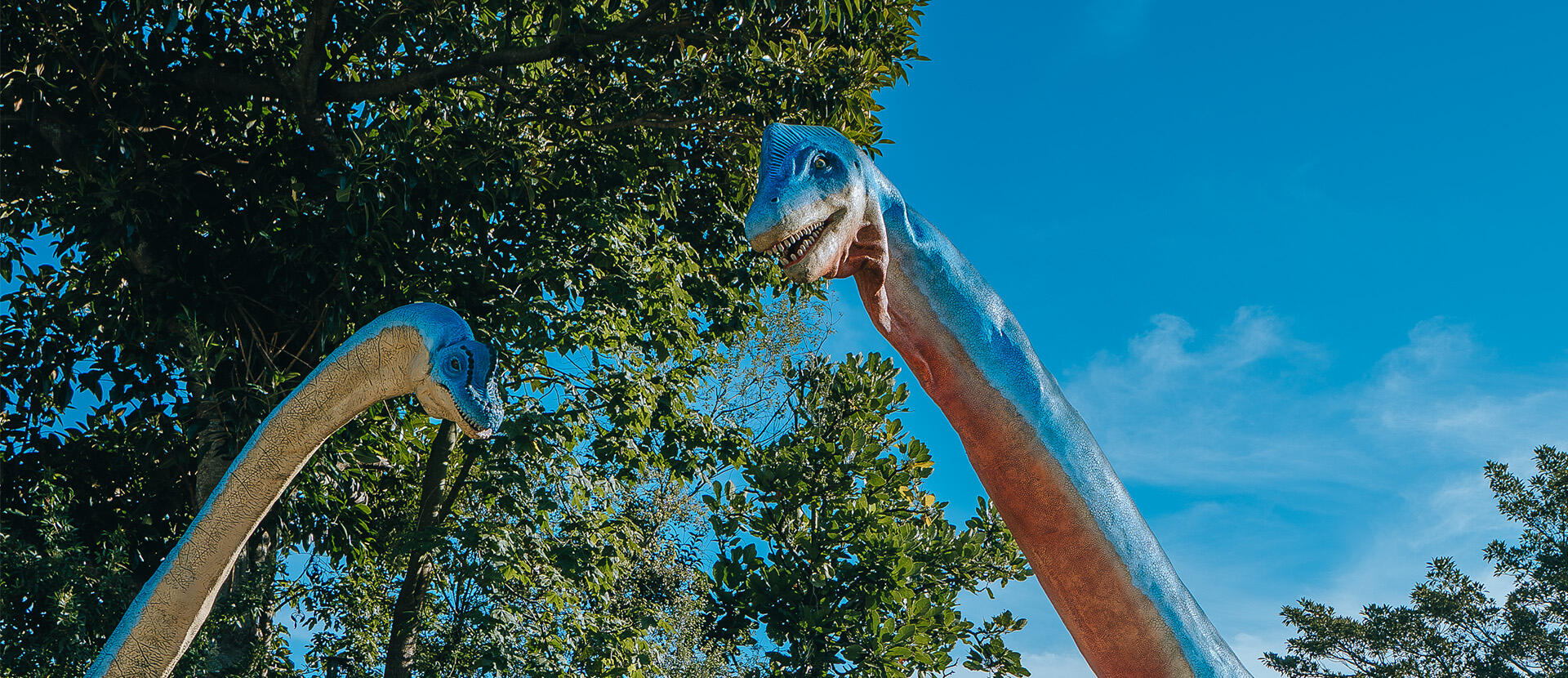
Brachiosaurus could grow up to 13m tall and had around 13 neck vertebrae.
How does this compare? Another long-necked animal you may see at the Zoo, the giraffe, has seven neck vertebrae (which is the same amount you have!). Giraffes have high blood pressure (nearly double the average human) to be able to pump blood up their necks. They also have a very large, powerful heart that weighs up to about 10kg or 0.5% of their body weight. Can you imagine how big the heart of a Brachiosaurus might have been? Soft tissue like a heart does not fossilise very well so it is hard to know for sure. But the largest giraffe at Auckland Zoo weighs about 1,300kg, and a Brachiosaurus is thought to have weighed around 50,000kg!
The jaw and teeth of a Brachiosaurus indicate it ate plants. But how much? Some scientists believe they would have had to eat up to 400kg of dry plant matter per day! For comparison, a mature pine tree or oak tree can have around 225kg of dry leaves.
Fossils can tell us a lot about dinosaurs. But finding a full dinosaur is not very common so putting them together is like doing a jigsaw with missing pieces.
Edmontosaurus was one of the largest of the group of dinosaurs called hadrosaurs. Hadrosaurs were large, plant-eating, duck-billed dinosaurs.
A very rare ‘dinosaur mummy’ of an Edmontosaurus was discovered. This specimen had preserved skin, muscle and tissue. The fossilised skin showed that Edmontosaurus was covered in round scales with larger pentagonal scales scattered throughout. Twigs, conifer needles and seeds have been found in the stomach of a fossilised Edmontosaurus which confirmed this species was a herbivore.
Scientists have discovered more than 40 specimens of Euoplocephalus. Fossil evidence suggests that the Euoplocephalus was solitary.
It is likely that Euoplocephalus lived in a woodland or wetland habitats. Its beaked mouth and leaf-shaped teeth indicate it was herbivorous, feeding on ferns, conifers and cycads.
Euoplocephalus was part of a group of dinosaurs called anklylosaurs known for their armoured bodies. Heavily armoured, Euoplocephalus had ridged bony plates called osteoderms over its back. Osteoderms can be seen on other animals around the Zoo – check out the alligators, Sunda gharial and lace monitors.
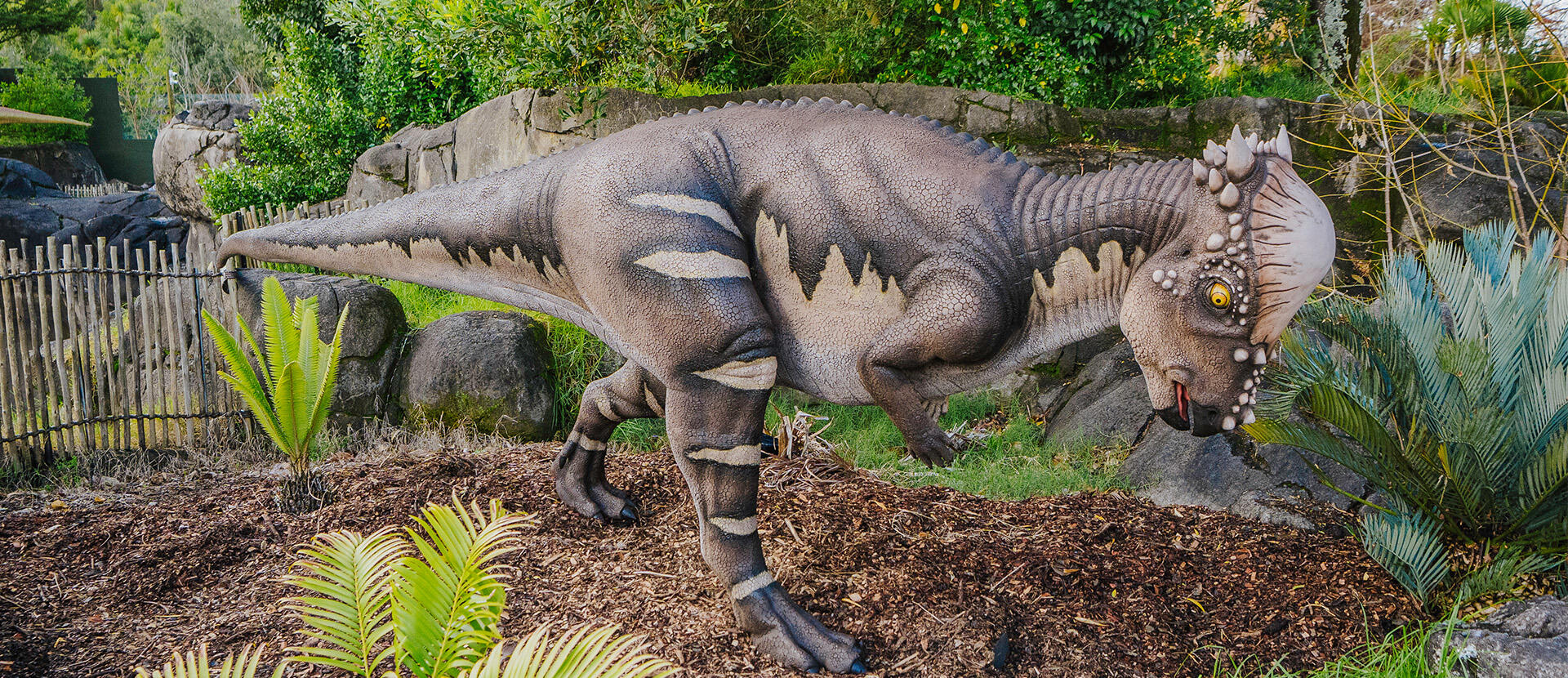
Pachycephalosaurus were thought to be herbivores. However, a discovery of a juvenile’s jaw showed teeth that most would describe as carnivore teeth, as they looked like small steak knives. This suggests, at least as young dinosaurs, they may have been opportunistic omnivores - feeding on small animals or carrion.
It is still up for debate, but some scientists believe that the dinosaur described as Dracorex hogwartsia (The Dragon King of Hogwarts) might be the juvenile form of Pachycephalosaurus.
Scientists are still unsure of the reason for their large dome head – it could’ve been used as a headbutting weapon, to recognise each other, or show off for a mate.
Pachyrhinosaurus was part of a group of dinosaurs called ceratopsids. Ceratopsids were horned, frilled dinosaurs that had strong beaks used for stripping vegetation and hundreds of teeth for cutting up plants.
Their thick nose, called a ‘nasal boss’ was thought to be used to fight with other Pachyrhinosaurus to show dominance.
It is thought that Pachyrhinosaurus lived in herds as multiple footprint tracks have been found together.
Some scientists believe the hollow crest of the Parasaurolophus was used for calling. In fact, when scientists tested this by blowing air through a modelled version, it did create a sound. Other scientists believe it was used to recognise other members of their species. And perhaps males and females had different sized crests, much like what we see in many antelope species today.
Parasaurolophus has been found with crests of different sizes and shapes. However, as it can be difficult to determine the sex of a dinosaur, it is unclear if the crest changed between males and females, or even from juvenile to adult.
Parasaurolophus was a duck-billed dinosaur that could walk on two or four legs. These dinosaurs were known to have a ‘dental battery’ – instead of individual teeth, they had multiple teeth stacked in columns to help grind their food. They would also constantly replace old teeth, much like a crocodile or a shark does today.
Fossils of Styracosaurus have been found close together, indicating they were a herd animal to help protect themselves from large predators.
Initially scientists thought there were three different species of Styracosaurus due to slight differences found in fossilised skulls. In particular the squamosal bone, which is a bone at the back of the skull, seemed to be a different shape. However, with further research it has been decided there is just one species of Styracosaurus.
The skull had two large openings on the frill section, making the skull lighter.
Styracosaurus are thought to have weighed up to 3 tonnes! That is nearly twice the weight of an adult rhino!
Come on a journey and discover the wonderful and mysterious world of dinosaurs.
A carnivore (an animal that eats meat), like a lion or tiger, has sharp teeth that aid in tearing …
Auckland Zoo is home to 130 species and over 2,800 animals. Learn more about Aotearoa's largest …