

Dinosaur Discovery Track
Come on a journey and discover the wonderful and mysterious world of dinosaurs.
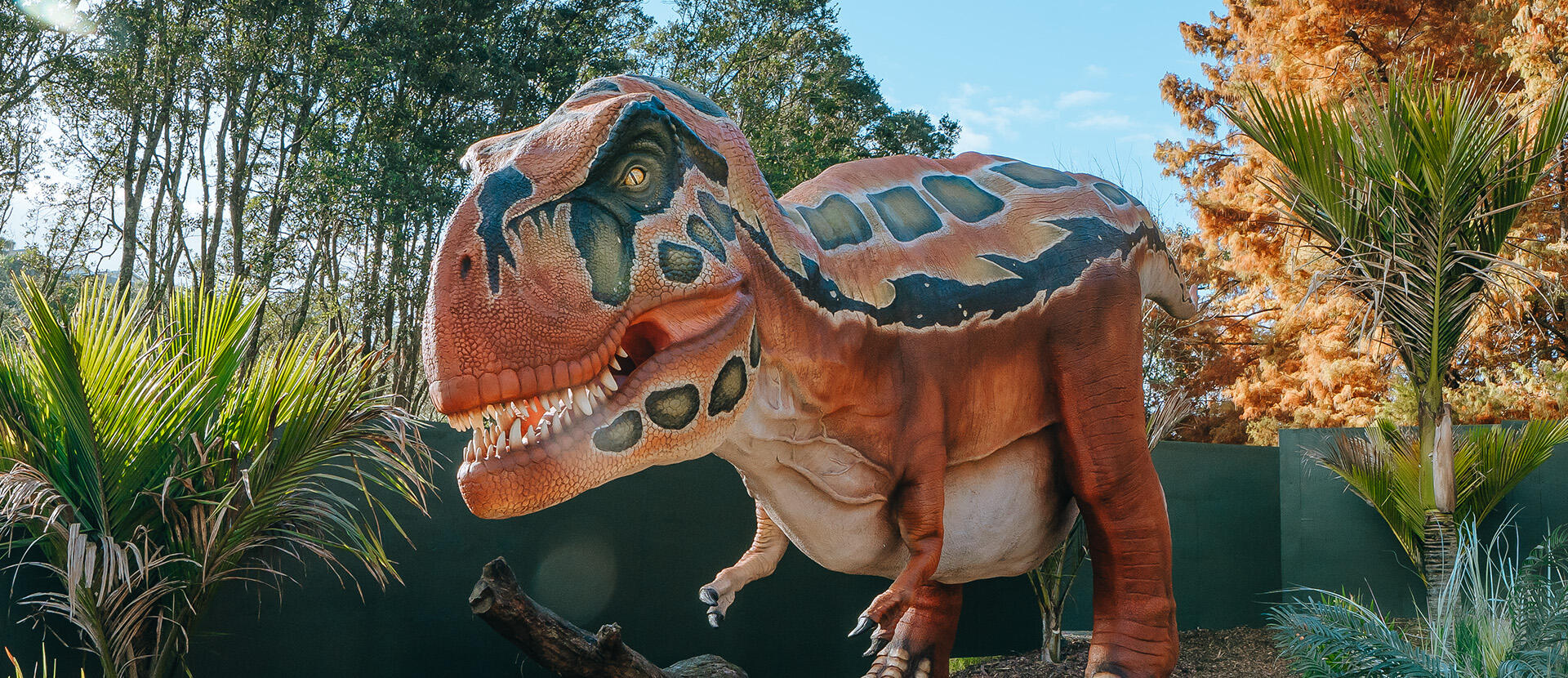
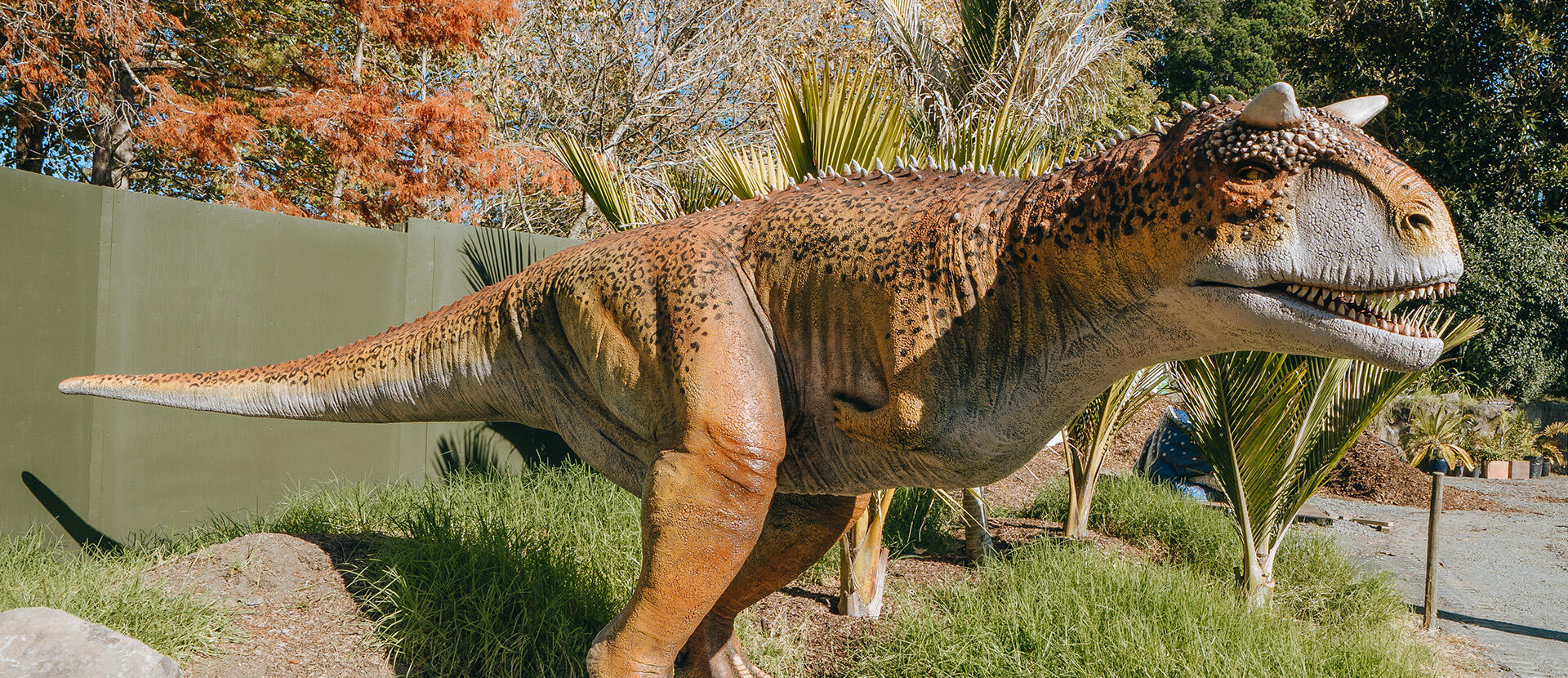
Meat-eating dinosaurs
A carnivore (an animal that eats meat), like a lion or tiger, has sharp teeth that aid in tearing meat off a bone. We can look at fossilised dinosaur teeth to give us clues to what dinosaurs ate, based on what we know of present-day animals.
Carnotaurus had very small arms which would have been virtually useless. These were likely vestigial arms. You may see some other species at the Zoo that have vestigial limbs. Ratites (birds including kiwi, emu and ostrich) have vestigial wings. They are still there, but do not support flight.
Scientists think Carnotaurus was very fast, but only in a straight line – much like a 100m sprint champion. Their huge muscular tail helped them to run fast, but the bulk of it made turning at speed difficult.
Although there may be similarities to the Tyrannosaurus, they were in separate family groups and evolved far apart, with the Carnotaurus dominating Argentina and the Tyrannosaurus dominating North America and Canada.
Fossilized skin of a Carnotaurus showed it was covered in scales, which may have helped with temperature regulation.
Cryolophosaurus was discovered in what is now known as Antarctica. 170 million years ago when Cryolophosaurus was alive, Antarctica was about 1000km further north and part of Gondwana so it had a much warmer temperature than it does today. Antarctica was covered in lush forest at the time Cryolophosaurus was alive.
Scientists are still debating what the crest on its head was for. Perhaps it was to attract a mate. As flesh and skin does not fossilise as well as bone does, the crest was potentially much bigger than we think.
Cryolophosaurus was the second dinosaur to be discovered in Antarctica. So far, there are about eight species of dinosaur that have been discovered in Antarctica. This does not mean there are not more to be found, but as you can imagine, fossil expeditions to Antarctica can be very challenging. Even when fossils are discovered, often they are only fragments, making it difficult to know what animal they are from.
Jurassic Park showed a Dilophosaurus that could spit venom. However, there is no fossil evidence that supports this. Unlike species of cobra that have specialised fangs to ‘spit venom’, nothing similar has been found in Dilophosaurus fossils. Fossil records can’t always tell the whole story so sometimes we use our imagination.
Crested dinosaurs like Dilophosaurus and Cryolophosaurus lived in the early Jurassic period. But were only around for a relatively short time. Crests become much less common in later dinosaurs. Scientists think crests like these may have evolved for display. Some later dinosaurs evolved to have feathers, which could have been a much more effective display.
Scientists believe Dilophosaurus were active predators rather than scavengers. This was for two reasons. The first was that they had a very strong jaw. The second was that their bones were found to be reinforced with air pockets in a honeycomb structure which made their skeleton strong but light - a combo perfect for chasing prey.
The first fossils of Ornithomimus that were discovered were a foot and part of a hand. They were so bird-like that it was given the name Ornithomimus – the bird mimic. As more fossils were discovered, it started to resemble an ostrich. Although this one does not have feathers, it is likely they did. The body feathers were likely short and fuzzy. The feathers on the wings were likely longer. And although they didn’t help the Ornithomimus to fly, they could have been used for display.
An Ornithomimus was discovered to have rounded stones in their stomach, called gastroliths. Some current birds have gastroliths to help with digestion. The combination of these gastroliths, a beak and no teeth indicated the Ornithomimus was an omnivore, with plants making up a large part of their diet. This is unusual for a theropod dinosaur. Most theropods (think Tyrannosaurus) were carnivores.
Ornithomimus had three toes per foot. An ostrich has two toes per foot!
Named for its similar snout to a modern crocodile, Suchomimus was likely a river hunter, specialising in catching fish. Hollow bones, which were common with theropod dinosaurs, indicate it would have waded in shallow water but not fully dive in. Over 100 conical shaped teeth curved inwards, allowing Suchomimus to hold on to prey. Many marine predators have backward pointing teeth for the same reason.
After finding the first fossil of Suchomimus, a thumb claw, the same team went on to discover 400 pieces of Suchomimus skeleton. The number of Suchomimus fossils found may indicate that it was one of the dominant predators of the time.
The thumb claw of Suchomimus could be up to 30cm!
Troodon was first described after finding just one tooth fossil. Over the years, Troodon has been grouped with a variety of different dinosaurs from carnivores to herbivores. Many other dinosaurs have also been misidentified as Troodon. Further fossils continue to give new information for this species.
Compared to other theropods, Troodon had a large brain. Part of this is due to their larger eyes. Scientists think they either had larger eyes to let more light in while hunting at night, or because they lived in a cooler climate with less sunlight hours. Their eyes were also front facing (like us), rather than on the sides of their face, indicating they had advanced binocular vision, which is good for carnivores hunting prey.
Troodon teeth were approximately 4mm in width – that’s smaller than your teeth!
To date, over 50 Tyrannosaurus skeletons, including some almost complete individuals, have been discovered. This has helped to prove that Tyrannosaurus walked with their tail off the ground, using it as a counterbalance. Although all these specimens have been found, scientists still do not know why Tyrannosaurus had such short arms.
Scientists can learn about dinosaurs from fossilised poo! In 1998 scientists described a coprolite (fossilised poo) that weighed more than 7kg! Inside they found broken bone pieces from a hadrosaur. The only dinosaur of the time and place capable of producing a poo that size would have been a Tyrannosaurus. The bone pieces help us know that a Tyrannosaurus bite was strong enough to crush bones. It is thought that their bite force is about 10 times that of an alligator.
It was originally thought that Tyrannosaurus could run over 40km/h. However, more recent modelling suggests that it was only 16km/h. Scientists think Tyrannosaurus eyesight was about 13 times better than the average person!
It is also thought Tyrannosaurus could live up to 30 years old. Scientists can figure this out by looking at growth rings in the fossilised bones – much like growth rings on a tree.
Scientists believe that carnivorous dinosaurs, including the Utahraptor used a “grip and rip” feeding style. Imagine the initial bite is like using a fork to hold prey. Then as they pulled backwards, the serrated teeth worked like steak knives to cut through the prey. Utahraptor also had a curved claw on each foot that was up to 24cm long!
There is currently no fossil evidence that Utahraptor had feathers. However, other raptors that are closely related are known to have feathers. A lot of dinosaur feathers have been found to be more like bristles, filaments and fuzz. It is likely that these feathers were used as a signal to establish dominance or attract a mate.
Utahraptor was the largest and oldest known dromaeosaurid (also known as ‘raptors’). Due to their size, it’s believed Utahraptor was not very fast and instead used an ambush style of hunting. Ambush hunting is either sitting and waiting or stalking prey before launching a surprise attack. Many animals that use this technique camouflage well in their environment.
Come on a journey and discover the wonderful and mysterious world of dinosaurs.
A herbivore is an animal that eats plant matter – like a giraffe or rhino – and has flatter teeth …
Auckland Zoo is home to 130 species and over 2,800 animals. Learn more about Aotearoa's largest …